
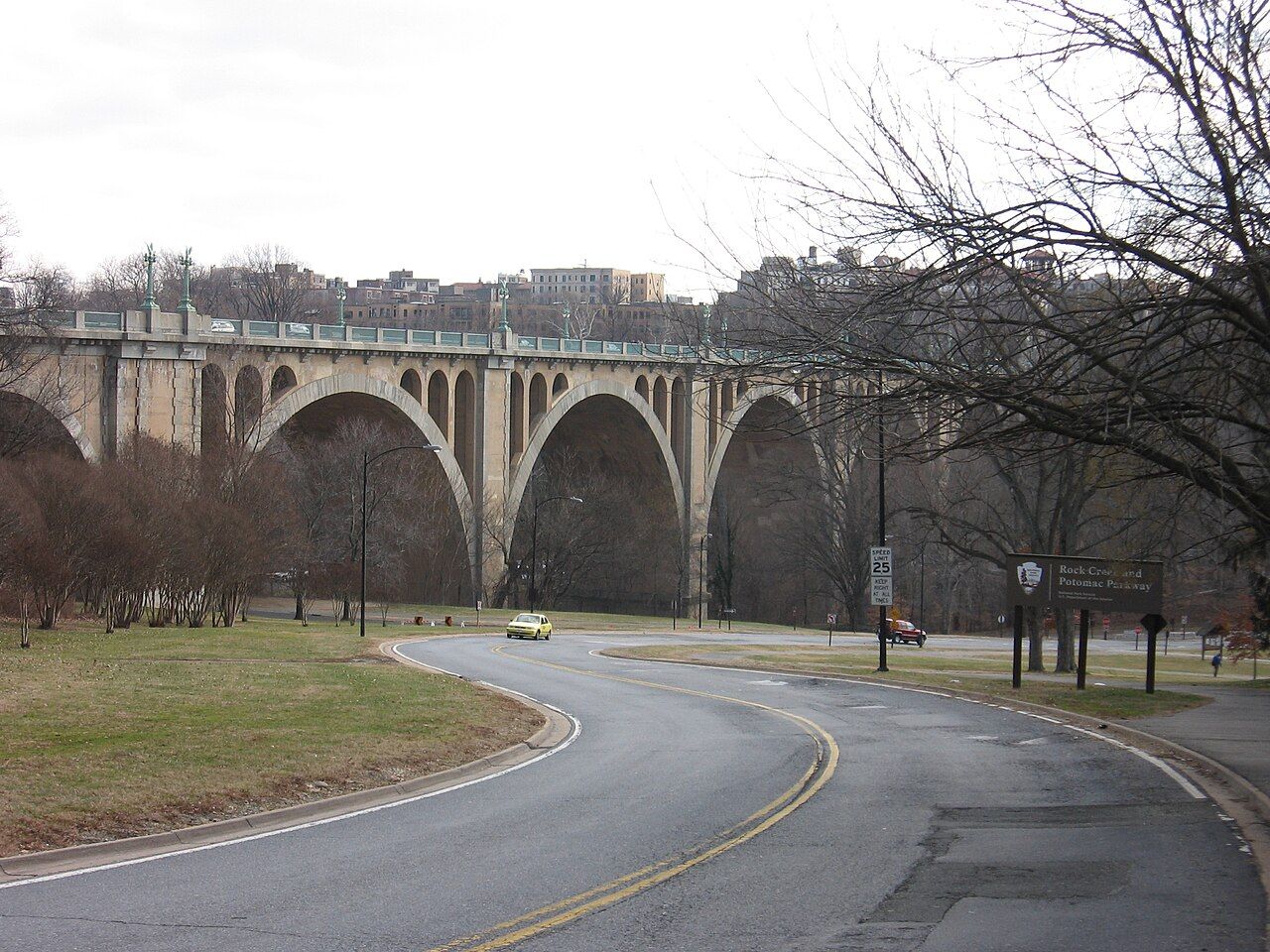
Adams Morgan stops abruptly on its western side. The rowhouses run out, the ground falls away into a deep wooded cut, and Rock Creek runs along the bottom with a parkway beside it. Two bridges deal with that drop: the Duke Ellington Bridge, which carries Calvert Street, and the Taft Bridge, which carries Connecticut Avenue a short way to the south. They land almost side by side on the Woodley Park side, so the pair makes a tidy loop of a little under an hour at an easy pace, with time to lean on the parapets.
The Duke Ellington Bridge
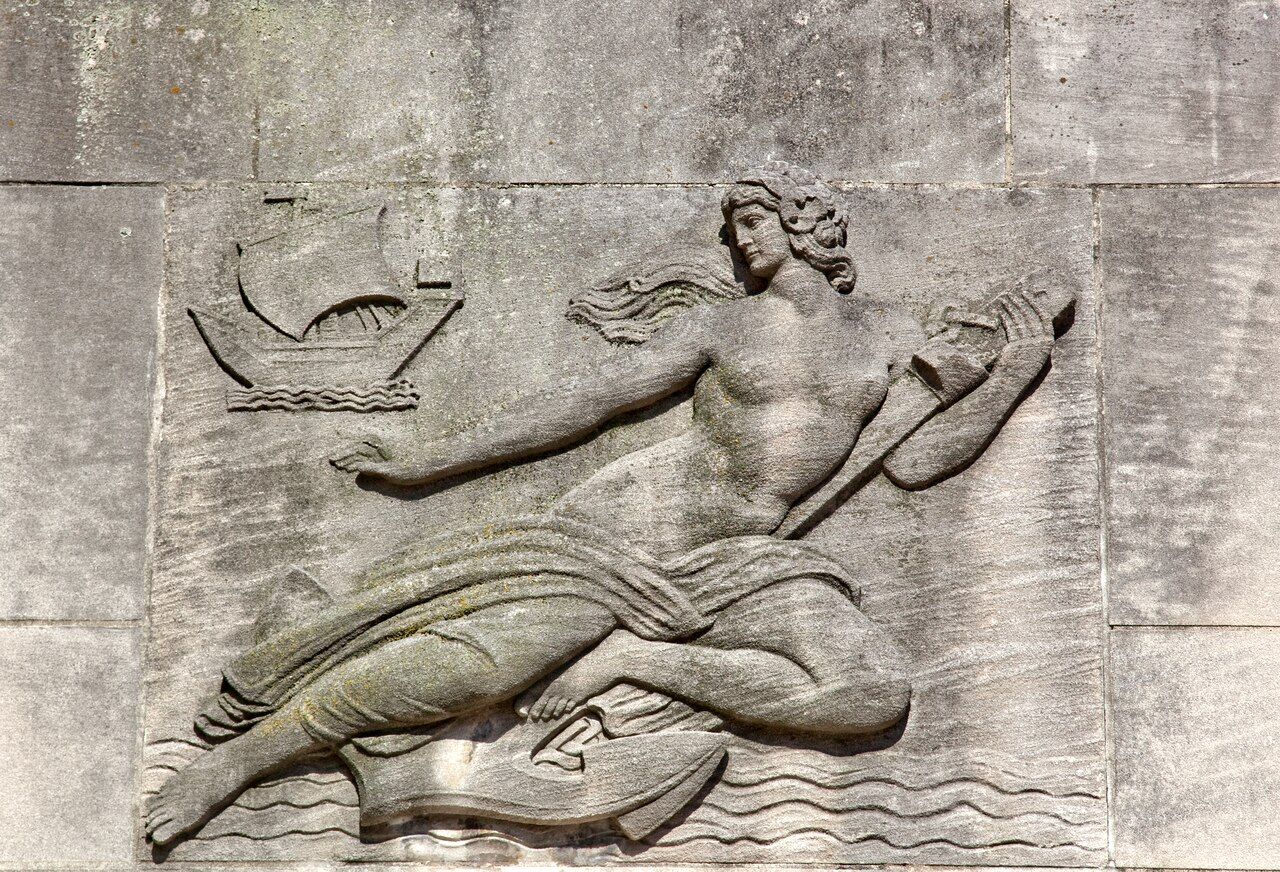
The Calvert Street crossing went up in the mid-1930s, a long run of three broad arches faced in pale stone. It is plainer than its neighbour, built in the stripped-down classical manner of the period, and its best details are low down at the abutments, where carved panels show ways of travelling: by air, by water, by road and by rail. You can see them from the sidewalk if you lean out at either end, or from the valley path below.
The bridge was renamed for Duke Ellington in the 1970s. The composer grew up a short way east, in the streets around the U Street corridor, and the name ties the crossing to that history; the story of that part of the city is told in our guide to U Street and Black Broadway.
Tall safety barriers line both sides of the deck.
The Taft Bridge and its lions
A few minutes south, the Connecticut Avenue bridge is older and more theatrical. Finished in the first decade of the twentieth century, it strides across the valley on a row of tall concrete arches, built at a time when concrete was still a bold material for a span of this size. It carries the name of William Howard Taft, who spent his later years living close by in Kalorama.
Two pairs of large concrete lions sit at the ends, one pair facing the city and one facing Woodley Park. They are calm, heavy-maned beasts, and they get more attention from children and photographers than anything else on the bridge. Along the railings, lampposts topped with eagles light the deck at night.
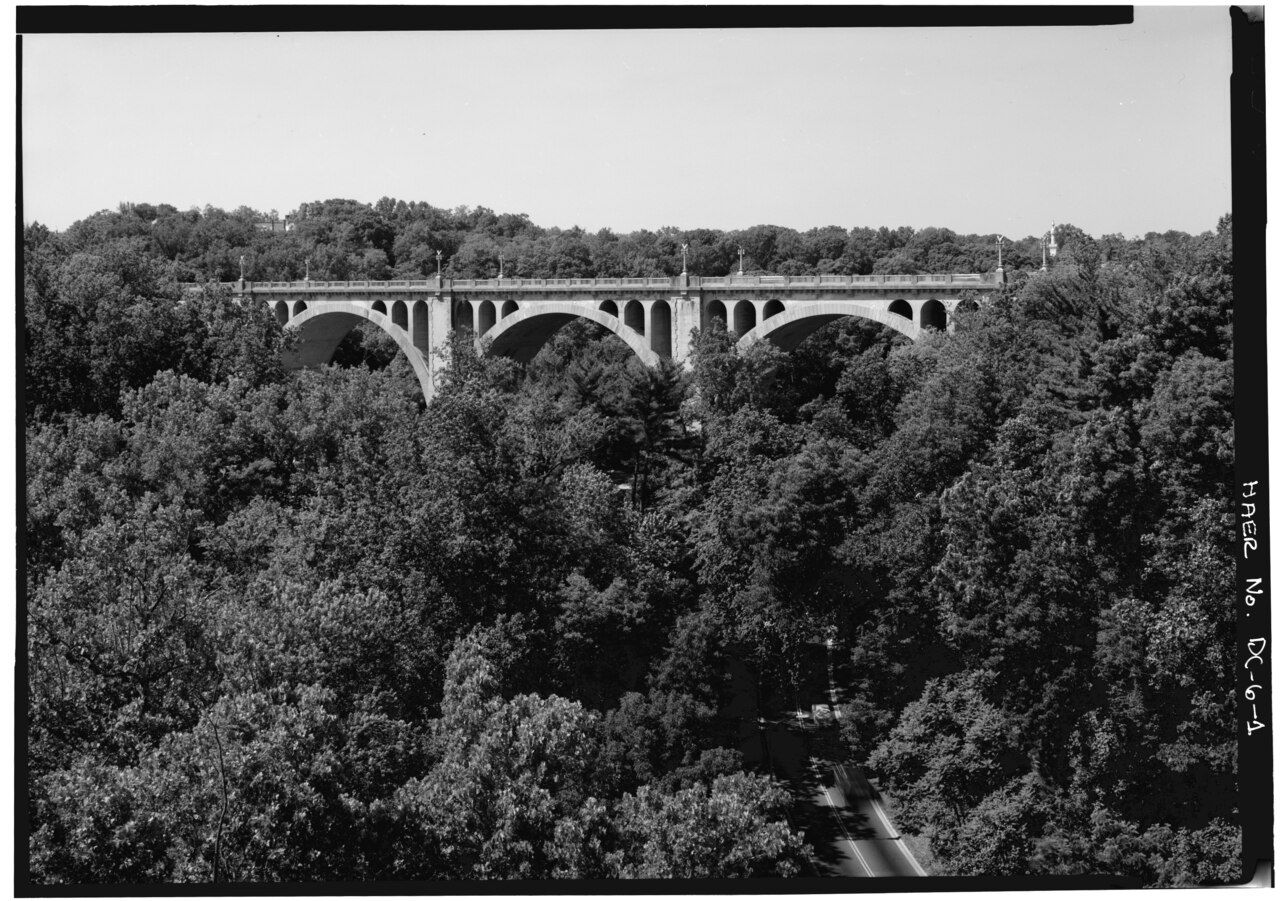
- Best view from the deck: the middle of the Taft Bridge, looking north up the valley toward the Ellington arches.
- Best view of the arches: from the path along the creek, looking up.
- Best spot for the lions: either end, early in the morning, before the sidewalks fill.
The valley underneath
Under both bridges runs the Rock Creek and Potomac Parkway, a park road laid out in the early twentieth century to carry traffic through the valley without spoiling it. Beside the road, a paved path follows the water south toward Georgetown and the Potomac and north toward the deeper woods of Rock Creek Park.
The road itself is not for walking. It is narrow, cars move quickly, and some stretches change direction at rush hours, so stay on the path and cross only where signs and crossings allow. Getting down to the path from the bridges is not straightforward either: there are steep informal trails, but the more sensible approach is to use the marked paths and park entrances, which add a few minutes and save a scramble. Check a map before you set out.
 Next door: StayingA year on the hill: seasons in Adams Morgan
Walking them at dusk
Both bridges are at their best in the last half hour of daylight. The sun sets roughly behind Woodley Park, so walking west over the Ellington Bridge you have the colour in front of you, and coming back over the Taft Bridge you see the lamps coming on along the deck and the headlights threading the parkway below.
- Find Calvert Street on the north-west edge of the neighbourhood and follow it west past the last apartment blocks.
- Cross the Ellington Bridge on the north sidewalk for the view up the valley.
- At the far end, turn left onto Connecticut Avenue; the Woodley Park Metro entrance is just to the north if you want to cut the walk short.
- Cross the Taft Bridge southbound, greeting the lions at both ends.
- From the Kalorama end, make your way east to Columbia Road and follow it back uphill to 18th Street.
The whole loop is a little over a mile. The only climb worth the name is the walk back up toward 18th Street, and it is short.
Seasons and weather
Autumn is the obvious time. The valley turns yellow and copper from the top down, and from the bridges you see the canopy rather than the trunks. Winter strips the trees and shows the creek itself, which you hardly notice in summer. Spring brings a green haze and some flowering trees on the slopes, and summer gives you deep shade below and very little breeze above.
Wind is the thing to expect. The gorge funnels air, and on a cool evening the middle of either bridge can feel noticeably colder than the street you just left. In a summer thunderstorm, which can arrive fast in the late afternoon, there is no shelter on either deck, so wait it out before you start.
Sidewalks, lamps and bikes on the spans
- Both bridges have sidewalks on each side and are lit at night. They are busy with people walking to and from the Woodley Park station, so you are rarely alone on them.
- Bikes share some of the space; keep to one side when you stop for photos.
- There are no toilets or water on the bridges. Woodley Park and the Connecticut Avenue end of Adams Morgan have plenty of places to stop.
- If you are heading on to the National Zoo, cross the Taft Bridge northbound and keep walking up Connecticut Avenue; the main entrance is a little way beyond the Woodley Park station.
From the south end of the Taft Bridge you are also at the edge of Kalorama, so the walk can turn into a longer afternoon among the big houses and flags of Kalorama and Embassy Row.
More from this block: Parks and the creek, or back to the six doors.